



15
May
May
MS PTFE Lined Pipe and MS PFA Lined Ball Valves in Acid Transfer Lines
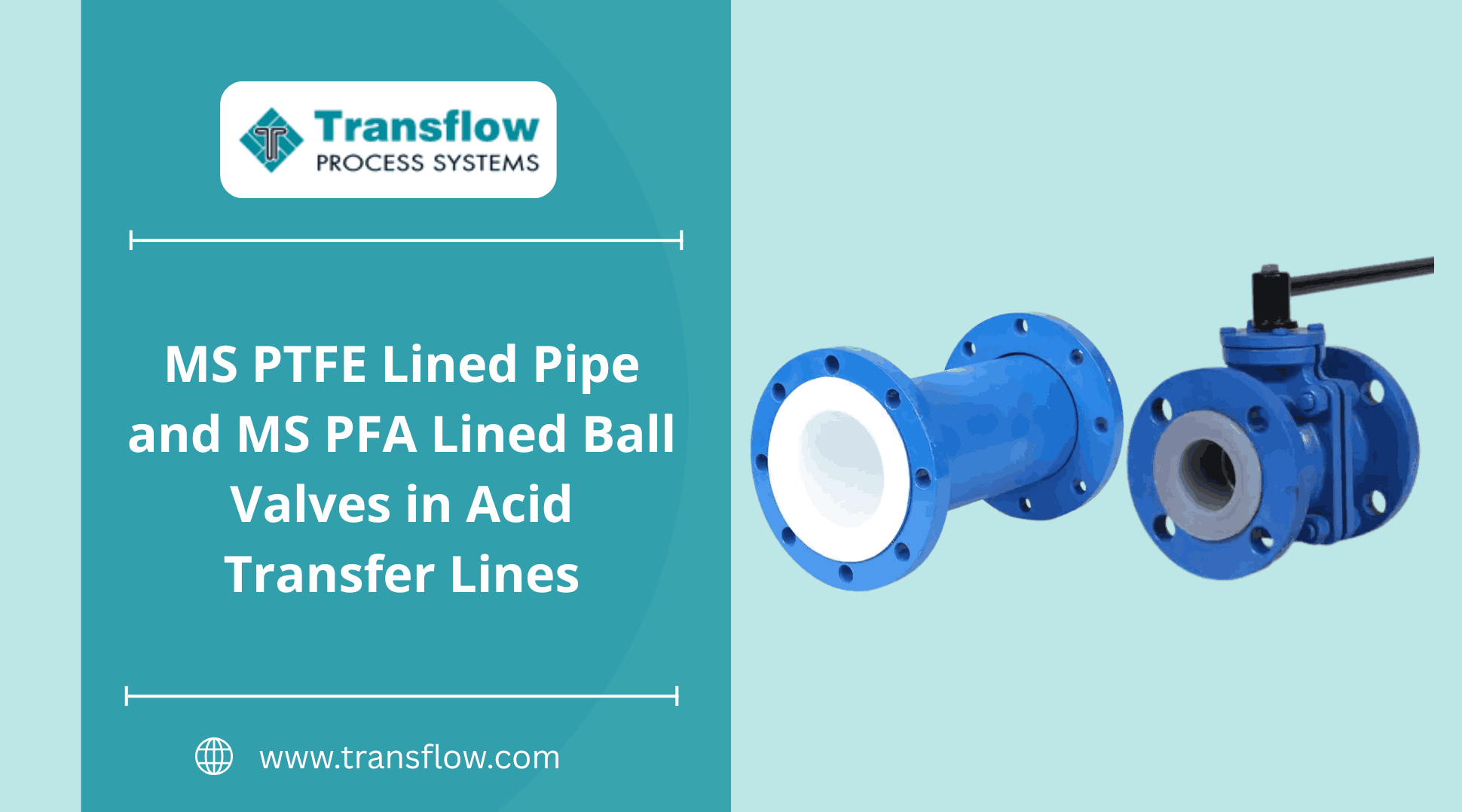
In corrosive chemical environments, acid transfer lines must ensure complete
containment and controlled movement of process fluids. These systems are
typically built using MS PTFE lined pipes for continuous flow and MS PFA lined
ball valves for isolation at critical points.
This combination allows plants to handle aggressive media safely without
exposing metal surfaces to chemical attack.
How Acid Transfer Lines Are Built in Chemical Plants?
Designing a secure fluid handling network requires precise component mapping.
Every segment of the infrastructure from bulk storage to the final process
vessel must be explicitly engineered to contain aggressive media and prevent
environmental release.
Flow Path from Tank to Process Line
Acid typically moves from the bulk storage tank through a Lined Dip Pipe
and directly into the main transfer network.
The flow is then routed across the plant using straight runs, bends, and tees
before reaching the final process reactor or distribution manifold.
This configuration serves as the foundational architecture for any
reliable chemical plant piping system.
Where PTFE Lined Pipe Is Used in the Line?
The PTFE lined pipe forms the main continuous flow path of
the transfer line.
These pipes are engineered to match ANSI B16.5 Class 150 flange
standards. These dimensions allow direct compatibility with standard plant
piping layouts without modification, accommodating typical industrial pressure
requirements effortlessly. The outer carbon steel housing provides the necessary
structural strength to span structural pipe racks safely.
Inside, a heavy-duty virgin PTFE liner handles continuous flow at
temperatures up to ~200°C. By maintaining structural stability under severe
thermal cycling, this corrosion resistant piping ensures the highly aggressive
media never contacts standard metal.
Where PFA Lined Ball Valves Are Installed ?
You do not place valves arbitrarily a Lined Ball
Valve is installed exactly where absolute isolation is mandatory.
In real-world setups, typical installation nodes include:
- Tank outlet isolation
- Pump discharge control
- Maintenance shutdown sections
These locations ensure controlled isolation without interrupting
the entire process line.
These PFA lined valves allow operators to safely lock out specific
pipeline sections for maintenance without needing to drain the entire plant
inventory.
What Happens at Valve and Pipe Interface?
This is where the actual fluid containment succeeds or fails.
When a PTFE lined pipe bolts directly to a lined valve, it creates
a tight polymer-to-polymer sealing interface under correct flange compression.
Proper bolt torquing prevents mechanical flange stress while ensuring the flare
faces mate perfectly.
There is no direct exposure of process fluid to metal at this
joint.
The corrosive media remains completely isolated from the carbon
steel housings that are holding the physical system together.
Why Using Only Lined Pipe Is Not Enough?
Acid always attacks the weakest point.
And in most transfer setups, that point is an improperly specified valve.
A plant can run 500 meters of premium lined piping, but standard
metallic valves will compromise the whole line. Protecting the pipe while
leaving the control points vulnerable is where most systems fail, leading to
seized valve handles, internal passing, or blown seals.
Material and Construction in Actual Installations
Mild Steel (MS) is the industry standard for the outer housing in
indoor operations. However, exterior plant conditions often dictate material
upgrades to combat aggressive atmospheric corrosion.
In industrial installations, external modifications often include
Carbon Steel (CS) or Stainless Steel (SS) housings along with strict safety
color coding.
Proper manufacturing ensures that these external modifications do
not affect internal lining dimensions or performance.
How Transflow Ensures Lining Integrity?
A lined system only works if the liner stays permanently locked to
the metal housing.
We utilize a Unique Lining Process that ensures the fluoropolymer
maintains an absolutely uniform thickness across the main bore and flare faces.
As a dedicated Unique Lining Process Manufacturer in India, our
proprietary method eliminates residual stress within the plastic matrix. This
prevents the liner from collapsing or deforming when the system experiences
sudden pressure drops or operates under severe full-vacuum conditions.
Testing Before System Deployment
You don’t guess with acid lines , you verify.
Before installation, every component is validated to ensure
performance under corrosive conditions:
- Spark testing verifies liner integrity.
- Hydro testing confirms structural strength.
- Helium leak testing ensures complete sealing.
Where This Combination Is Actually Used ?
This specific pairing of PTFE lined pipe and PFA lined valves is
deployed wherever standard steel would dissolve in a matter of weeks.
It forms the reliable backbone of bulk chemical plants handling
aggressive hydrochloric, sulfuric, or hydrofluoric acids.
Active Pharmaceutical Ingredient (API) plants also rely on this
infrastructure because the chemically inert lining guarantees zero contamination
for highly sensitive batch processing.
What Defines a Reliable Acid Transfer System ?
A reliable acid transfer system is not defined by individual
components, but by how the pipe and valve function together as one continuous,
corrosion-resistant system.
A transfer line is only as strong as its weakest joint.
When flow routing and isolation points use compatible lined
components, system weak points are eliminated and performance remains consistent
over time.
For project-specific requirements, Transflow supplies MS, CS, and
SS lined piping components with engineering support based on plant conditions.
To discuss exact material specifications and integration for your facility,
contact our engineering team.