



09
Feb
Feb
PTFE Lined Pipe vs. Solid Plastic Piping: Structural Differences for Corrosive Service
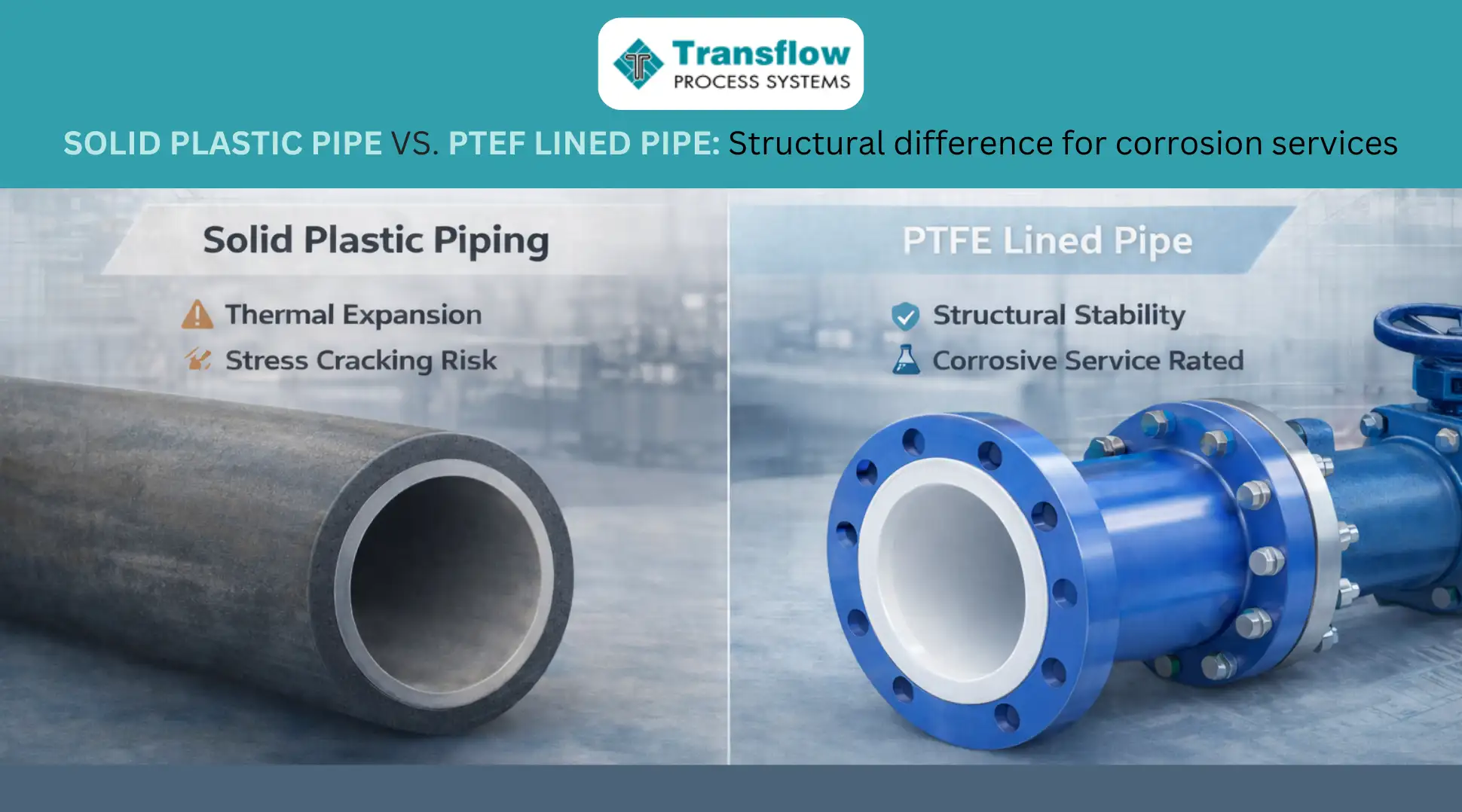
In process engineering, cost-effective is frequently a euphemism for a deferred maintenance problem.
A common scenario involves a specification calling for solid plastic piping to optimize initial CAPEX. However, without accounting for thermal cycling or stress cracking, such systems often develop integrity issues particularly at flange necks within the first year of operation.
At Transflow, we view material selection as a structural decision, not just a chemical one. This guide breaks down the engineering criteria for upgrading from commodity thermoplastics to PTFE lined pipe for critical corrosive service piping.
The Engineering Disconnect: Hoop Stress
The fundamental limitation of solid plastic is that the material must simultaneously resist chemical attack and retain mechanical load.
In a solid plastic piping system, the polymer does two jobs : stopping corrosion and holding pressure. As process temperatures rise, this becomes a conflict of interest. Thermoplastics soften when hot. An HDPE pipe rated for 10 bar at ambient temperature might barely hold 4 bar at 60°C.
Lined piping systems decouple these functions:
- The Steel : Manages hoop stress, vacuum ratings, and support loads.
- The Liner : Provides the chemical isolation.
This composite design allows PTFE lined pipe to operate at elevated temperatures (typically up to ~230°C, subject to liner grade) where solid plastics would often exceed their mechanical design envelope.
1. Field Problems (And How to Solve Them)
Thermal Expansion Control
Unrestrained solid plastic can expand significantly more than carbon steel often by an order of magnitude. If you run a long header of HDPE pipe, it snakes.This necessitates complex expansion loops or continuous support trays to prevent sagging and stress concentrations.
In contrast, lined piping systems are mechanically restrained by the steel housing. They behave like carbon steel, allowing for standard ASME B31.3 support spacing. This simplifies the piping layout and reduces structural steel requirements.
2. Flange Integrity (Cold Flow)
Thermoplastics are susceptible to creep (cold flow) under sustained load. When you torque a flange on a PVDF pipe or HDPE line, the material slowly relaxes away from the bolt load. Over time, bolt tension drops, and the joint leaks.
PTFE lined pipe utilizes a flared liner face compressed against a rigid steel flange. The steel maintains the bolt tension, ensuring the seal stays tight even when the process temperature fluctuates.
3. Permeation Management
In services involving small molecules (e.g., Chlorine, HCl), permeation through the polymer wall is a known risk. In solid plastic systems, this can attack external supports or create environmental hazards.
Lined piping systems typically incorporate vent holes in the steel shell to manage permeation-induced pressure. This mitigates the risk of liner collapse—a common failure mode in vacuum service that solid pipes cannot easily address.
Material Selection Guide
Material choice usually comes down to temperature, pressure, and permeation resistance.
| Material | Application Scope | Engineering Considerations |
|---|---|---|
| HDPE Pipe | Water, Brine, Effluent. | Mechanical strength declines significantly above ambient temperatures. Poor resistance to strong oxidizers. |
| PVDF Pipe | Halogen Service (Br₂, Cl₂). | Excellent permeation resistance typically limited to ~120°C. Can be brittle compared to lined steel in impact scenarios. |
| PTFE Lined Pipe | Broad Chemical Service. | The industry standard for wide-range resistance (pH 0-14), subject to specific compatibility review. |
| PFA Lined Pipe | High Purity / Vacuum. | Lower void content than PTFE often preferred for vacuum service to mitigate liner collapse risks. |
Critical Components
System reliability relies on consistent material specifications across the entire loop.
A lined ball valve provides isolation without the stem breakage risks sometimes associated with solid plastic valves under high torque. Similarly, standardizing on lined pipes and fittings guarantees dimensional compatibility (ANSI B16.5), simplifying future maintenance and spool replacement.
Decision Framework: When to Upgrade
Engineers typically upgrade from solid plastic piping to lined piping systems when process conditions exceed the reliable operating window of thermoplastics:
- Elevated Temperatures : When operating temperatures rise above 60-80°C, pressure ratings for HDPE pipe drop significantly.
- High Pressure : For systems operating >10 Bar, solid plastic requires substantial wall thickness (low SDR), increasing weight.
- Vacuum Service: PFA lined pipe with bonded liners is frequently specified for vacuum duties to prevent liner collapse.
- Reactor Internals: For lined dip pipes and drop tubes, the fluid drag inside a tank will snap a plastic probe. You need the steel core rigidity.
Conclusion
Solid plastic piping is effective for utilities and mild effluent, but for aggressive chemical processing, the structural stability of lined steel is often non-negotiable.
Process engineers should validate all material selections based on specific pressure-temperature curves. Whether specifying PTFE lined pipe for a new manifold or assessing corrosive service piping upgrades, the priority remains system integrity and personnel safety.
For detailed specifications or to review our spark testing protocols, visit our manufacturing facility page or explore more on our Blogs page.