



18
Feb
Feb
Why Lined Piping Systems Fail in Corrosive Service ?
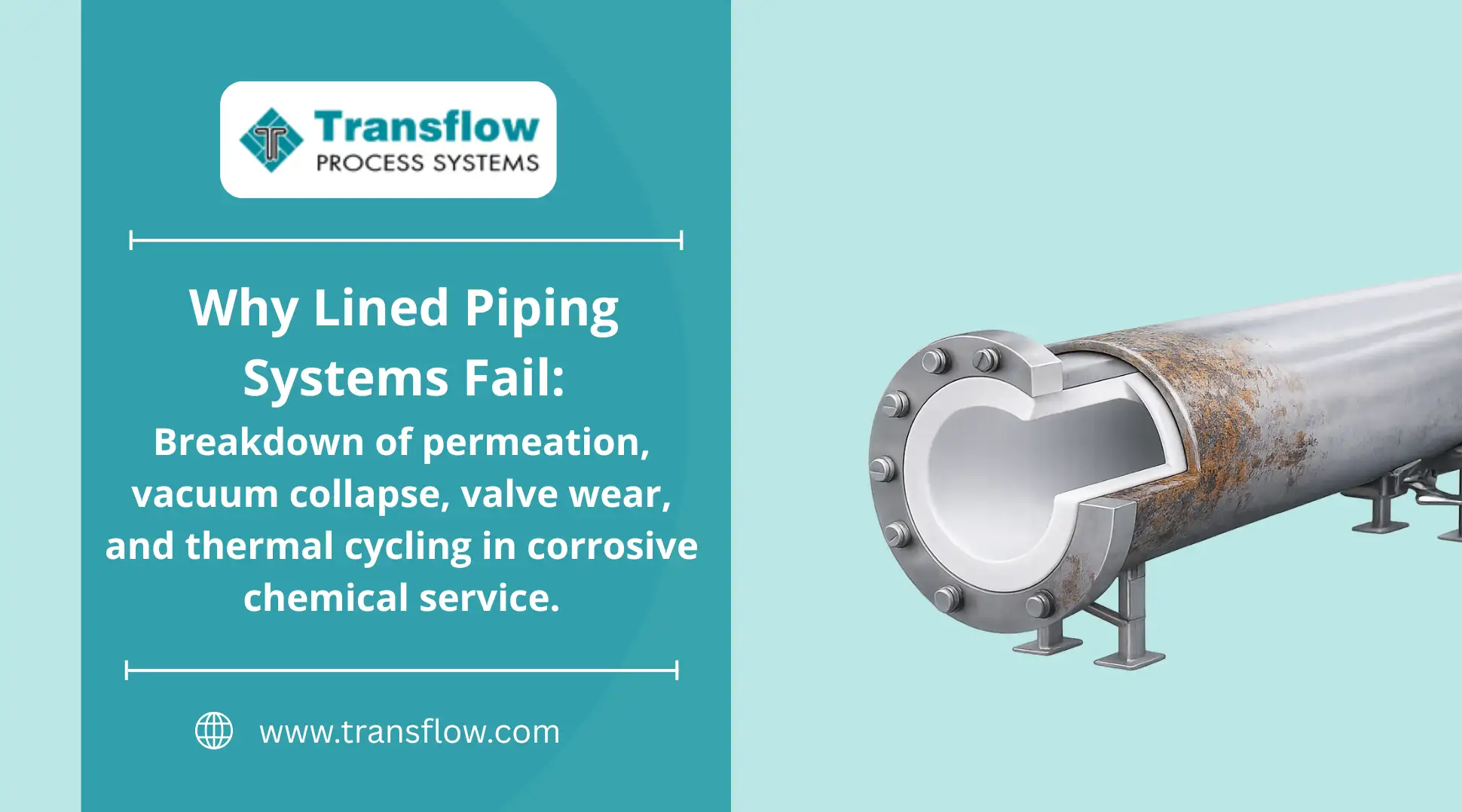
The most expensive failures in a chemical plant aren’t the catastrophic bursts
that happen on startup. Those are usually installation errors.
The expensive ones are the failures that happen eighteen months in.
You walk past a line that has been operating within pressure and temperature
limits since commissioning. Suddenly, you see weeping at the flange, or worse,
external corrosion on the steel housing while the liner inside appears intact.
The process fluid didn't change. The pressure didn't spike.
This is the uncomfortable reality of corrosive service
piping: chemical compatibility charts often give engineers a false sense
of security. Just because PTFE resists the acid doesn't mean the piping system
survives the physics of the application.
Here is why these systems actually fail, and the specific failure
modes that standard specifications often miss.
The Permeation Trap
One of the most insidious failure modes in PTFE lined pipe is permeation.
It’s not a leak. It’s molecular migration.
Dense gases (like Chlorine or HCl) can pass through the molecular
structure of the liner. They don't damage the liner itself. Instead, they
condense between the liner and the steel housing. The corrosion happens from the
inside out, hidden from view until the steel shell is compromised.
This often shows up months later.
Solid plastics don't have the structural backing to hide this, but
they lack the hoop strength for high-pressure lines. In lined systems,
preventing this requires specific manufacturing controls regarding liner
density. This is why our unique lining process focuses on maximizing
crystallinity essentially creating a tighter molecular barrier against this
migration.
If your specification ignores liner density in favor of generic
material grades, you are engineering a future shutdown.
Vacuum Collapse: The Overlooked Stress
Engineers focus heavily on positive pressure ratings. However,
lined piping systems frequently fail due to accidental vacuum conditions
that were never in the P&ID.
Consider a steam-cleaning cycle. The line is hot. The steam is
shut off. As the system cools, the remaining vapor condenses, creating a
localized vacuum. If the liner isn't bonded or locked correctly into the
housing, it pulls away from the steel and collapses inward.
Once the system repressurizes, the collapsed liner cracks.
This also fails when lining quality controls are inconsistent
across spools and fittings.
That sounds obvious until it isn’t. Many standard specs fail to
account for the vacuum created during upset conditions, not just normal
operation. This is a structural limitation where solid plastic piping
(like polypropylene) might actually survive due to rigidity, but fails on
temperature or chemical resistance. For lined systems, the fix isn't better
plastic. It is ensuring the liner is mechanically locked to the steel housing.
The Weak Point: Valves and Moving Parts
Static pipe spools are forgiving. Valves are not.
In the broader category of lined valves, the liner is subjected to dynamic
mechanical stress, not just chemical attack. A common failure point we see
involves the hinge mechanism in check valves.
A standard lined swing check valve relies on the liner to protect the
moving disc and the body. If the flow velocity is too low, the disc chatters.
This constant mechanical impact wears through the liner at the hinge pin or the
seat.
Conversely, if the flow is too turbulent, it can erode the liner
surface a phenomenon often seen in abrasive slurry applications where an HDPE
lined pipe might outperform fluoropolymers due to better abrasion
resistance, even if its chemical resistance is lower.
Engineers often treat valves as commodity items, but in corrosive lines, the
valve geometry dictates the lifespan of the liner.
Thermal Cycling and Flange Creep
Plastic expands roughly 10 times more than steel when heated.
In a process with frequent temperature swings, the liner faces of the pipe
expand, pushing against each other at the flange. When the system cools, the
plastic contracts, but it doesn't always return to its original shape. This is
cold flow.
Eventually, the tension on the bolts drops. The flange leaks.
Tightening the bolts again is a temporary fix that often crushes the liner face,
accelerating failure. This is why material selection matters immensely. Whether
you are specifying a complex lined jacketed ball valve or a simple spool, the
expansion rates must align with the cycling frequency. While PTFE is the gold
standard for chemical inertness, a PVDF lined pipe offers higher
mechanical strength and resistance to cold flow, provided the temperature limits
align with your process.
Understanding these trade-offs is key. You aren't just buying
chemical resistance; you are managing thermal expansion differentials.
Decision Logic: When to Upgrade
If you are seeing frequent flange leaks or unexplained corrosion on pipe
exteriors, replacing the spool with the exact same spec will only reset the
clock on the next failure.
More effort doesn't always fix this. Better engineering does.
You need to evaluate the liner thickness and the manufacturing
quality of the locking mechanism. When the process involves high permeation
risks or vacuum conditions, standard commodity piping is a liability.
Review your current failure rates. If you are dealing with repeated liner collapse or permeation corrosion, it is time to look at the quality testing behind your piping components. Controlled processing is what prevents these structural deficits.
A focused application review often helps determine whether a standard PTFE solution is sufficient or if the application demands a more specialized lined configuration . Contact Us